Built on Mistral
There's a quiet contradiction in how Europe talks about technology. We invoke sovereignty like a mantra — and then, when it's time to actually build, we reach for what's already dominant, because it feels safe. The intention is sincere; the execution gives it away. Sovereignty…


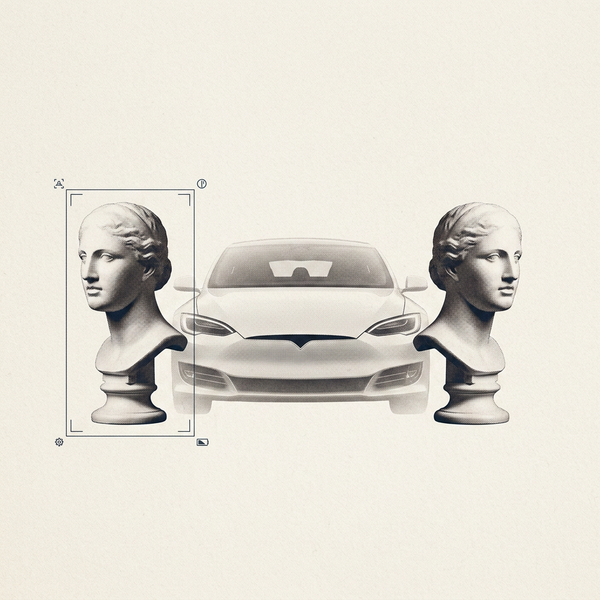
There's a quiet contradiction in how Europe talks about technology. We invoke sovereignty like a mantra — and then, when it's time to actually build, we reach for what's already dominant, because it feels safe. The intention is sincere; the execution gives it away. Sovereignty isn't a setting you switch on when it's convenient. It's either the premise of the whole system or it's decoration. We chose the premise. For the past year we've run an entire strategy studio — people and AI together — on European models, end to end. No hybrid fallback to US frontier models. No asterisks. This isn't a manifesto. It's a system that's been running.
What does "running" mean, concretely? It means an AI that carries a voice and a persona through a real client meeting — not a scripted demo, but a live conversation where it has to listen, reframe, and keep its footing. It means agentic workflows in production: drafting, researching, following up, moving work forward overnight. It means documents read, calls transcribed, a morning briefing assembled — all on European infrastructure, with data residency in Europe by default rather than as an upgrade you negotiate for. None of this is exotic, and that's the point. The ordinary, unglamorous middle of the working day now runs on a European stack, and the building didn't collapse.
The reason this matters is dependency. Every non-European model you wire into your core isn't just added capability — it's a support beam from the other shore. Your data, your reasoning, your operational logic begin flowing through systems governed by incentives and jurisdictions that aren't yours. If your AI can be throttled, logged, or silently changed by a place you don't inhabit, your sovereignty is conditional. And conditional sovereignty isn't sovereignty. The bridge may still stand, but it's no longer yours.
I won't pretend the price isn't real. There are moments when the frontier gap shows — a model hesitates on a fine cultural nuance, a workflow needs an extra layer of validation, an enterprise guarantee like zero-data-retention turns out to be gated behind a scale a small European team doesn't yet have. These aren't failures. They're the cost of conviction. The honest question was never "can European models match the US frontier on every axis." It was "are we willing to accept the trade-offs of building on our own terms." For us the answer has been yes — not because it's easy, but because it's consistent. You build around the gaps instead of pretending they aren't there, and what you get is a system that is actually yours.
What holds it together isn't the model. It's the form. We work as a Transparent Duett — human and AI side by side, in the open, the human always visible as the author and the AI always visible as the tool. When you trust the model underneath, you can afford that transparency: show the prompts, the iterations, the misses. The AI is a collaborator, not a black box. And when the model is European, the transparency runs all the way down — to where the data lives, to the legal safeguards, to values that aren't merely declared but built into the infrastructure. That is what A New European Techno-Humanism looks like once you stop writing about it and start operating it.
So the larger point isn't really about Mistral, or any single model. It's about what you discover when you take sovereignty seriously enough to build on it: that it isn't a static state but a practice. You make engineering trade-offs. You accept that some features arrive later. You compensate for gaps instead of hiding them. And you do it not as sacrifice but as a kind of self-respect — because sovereignty, in the end, isn't isolation. It's agency: the right to make your own mistakes, set your own priorities, and define your own version of progress.
If you're building something sovereign too — and quietly wondering whether the European stack can really carry the weight of real work — it can. Not effortlessly, not everywhere, but really. The bridge starts and ends in Europe, and it holds. If that's the kind of thing you're building, we'd love to compare notes.